Liquid Waterproofing Membrane Systems: Engineering Comparison & Specification
A liquid waterproofing membrane (LAM) is a monolithic, fully-bonded fluid chemical system that cures into a seamless elastomeric protective barrier. Applied by airless spray, roller, or notched squeegee, liquid applied membranes conform perfectly to intricate architectural profiles, flashings, and penetrations, eliminating lap-joint seams which represent over 90% of failures in traditional sheet waterproofing systems.
Why Civil Engineers Prefer Liquid Applied Membranes Over Traditional Sheet Systems
Over 90% of structural water ingress stems from failed seams, compromised torch welds, and inadequate termination details in preformed sheet membranes. CHEMPU liquid applied systems cure in-situ to deliver an uninterrupted, fully vulcanized envelope chemically fused to concrete, steel, and masonry.
100% Monolithic Barrier
Continuous fluid application eliminates all seams, joints, and overlaps. Penetrations, parapet walls, and geometric junctions are encapsulated without weak lap welds.
Zero Water Tracking
Liquid prepolymers deeply penetrate concrete micro-capillaries to achieve 100% full-surface adhesion. If localized mechanical puncture occurs, water cannot migrate underneath.
Cold Fluid Application
Ready to apply directly from pails by roller, brush, or airless spray. Zero torches, hot asphalt boilers, or open flame hazards, fully compliant with urban fire safety codes.
Rapid Localized Repair
Pinpoint defect remediation: clean the damaged sector and reapply liquid membrane. The new polymer chemically welds to the existing layer without stripping adjacent roofing.
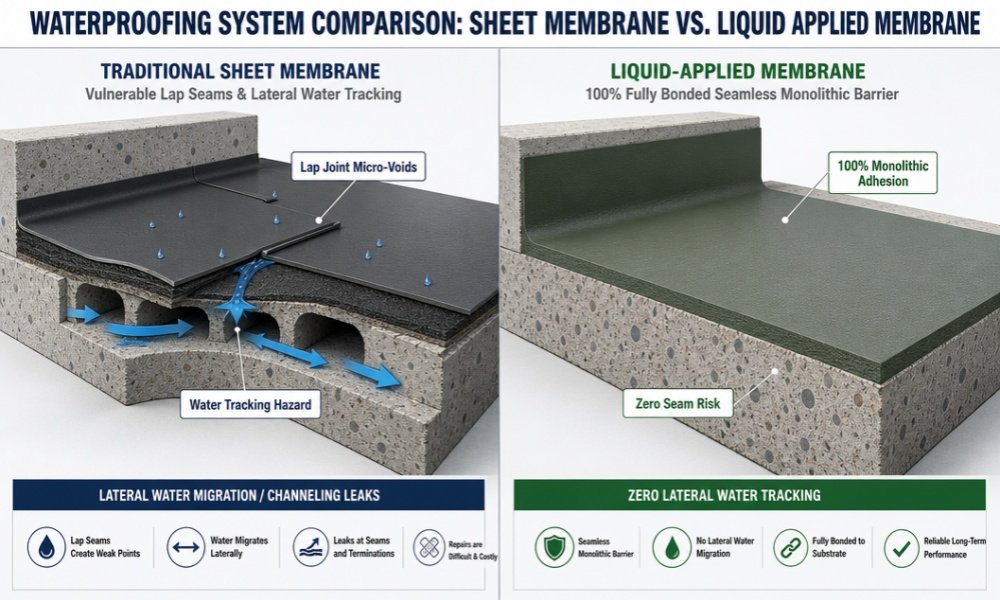
Micro-Interlocking Adhesion vs. Mechanical Point Contact
Traditional preformed sheet membranes (such as SBS torch-on or PVC rolls) rely on physical laying or localized torch melting, creating microscopic gaps between substrate and membrane where moisture can migrate laterally for meters before emerging indoors.
- Seamless Encapsulation: Fluid liquid polymer flows around irregular rebar protrusions, HVAC supports, and complex multi-pipe clusters.
- Superior Crack Bridging: Dynamic elastomeric properties bridge newly formed structural micro-cracks up to 2.5 mm under cyclic thermal expansion.
- Cost-Effective Lifecycle: Up to 35% reduction in 20-year structural maintenance costs by eliminating systemic seam debonding.
| Engineering Performance Metric | CHEMPU Liquid Applied Membrane (LAM) | Torch-Applied Bitumen Sheet (SBS/APP) | Single-Ply Polymer Sheet (PVC/TPO/EPDM) |
|---|---|---|---|
| Joints & Seam Integrity | 100% Monolithic (Zero Seams) | Lap seams every 1.0 m (Failure-prone) | Hot-air welded seams (Prone to workmanship errors) |
| Substrate Adhesion & Tracking | 100% Full-Bond (No Lateral Water Migration) | Spot/Partial bond (Water migrates beneath sheet) | Mechanically fastened or loose laid with ballast |
| Complex Detailing & Penetrations | Fluid conforming to any geometry | Requires cutting, patching, and multiple torch laps | Requires preformed boots and clamp rings |
| Fire & Installation Safety | Cold fluid applied (Zero open flame) | High fire hazard (Open gas torch required) | Hot-air welding or chemical adhesives |
| Dynamic Elongation at Break | 300% to 1000% (Rubber-grade elasticity) | 30% - 50% (Relatively rigid, tears under shifting) | 250% - 400% (Moderate flexibility) |
| Maintenance & Local Repair | Clean and recoat defect in minutes | Difficult to locate leak source under membrane | Requires finding hidden puncture and hot-welding patch |
| 20-Year Lifecycle Cost | Lowest (Minimal maintenance overhead) | High (Frequent seam resealing and leak repair) | Medium to High (High initial specialized labor cost) |
The 3 Core Chemical Systems: Polyurethane vs MS Polymer vs Acrylic
Selecting the optimal liquid membrane chemistry depends on exposure to UV solar radiation, expected mechanical traffic, substrate moisture levels, and environmental VOC regulations. CHEMPU engineers three distinct polymer matrices to cover every commercial scenario.
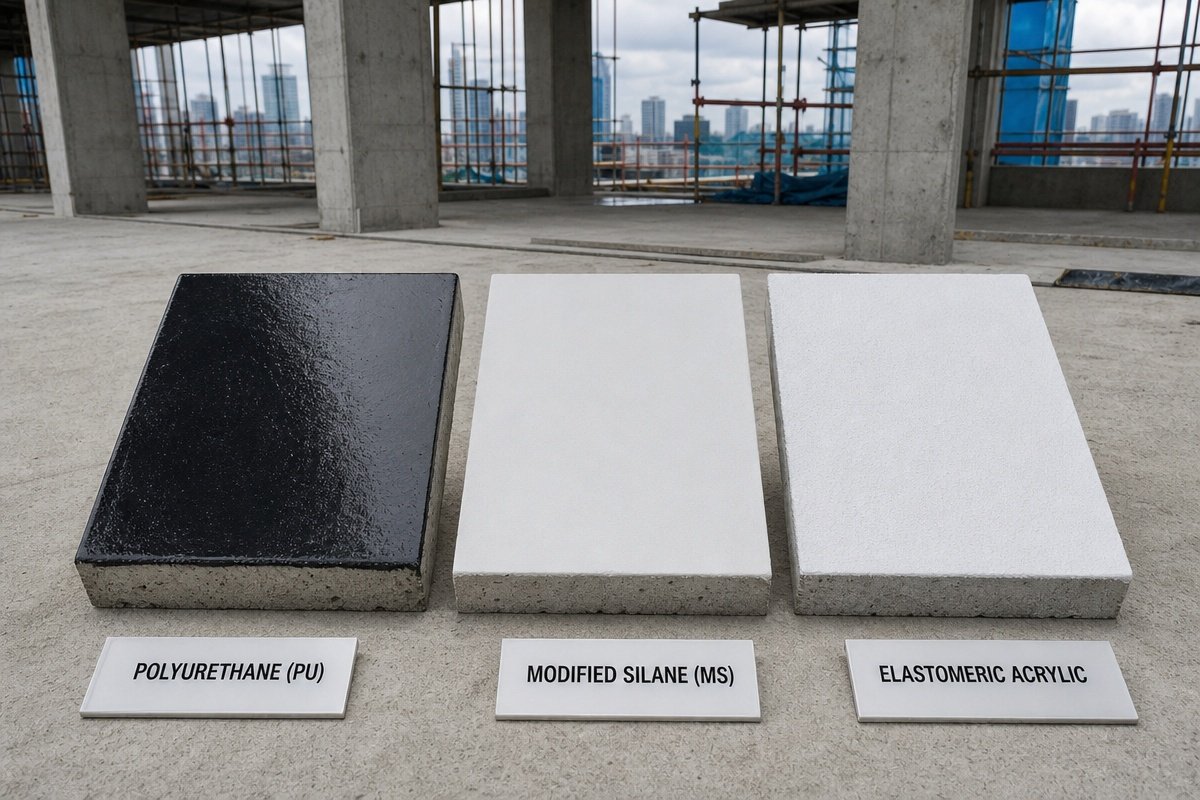
High-Polymer Synthesis for Diverse Engineering Stress
From heavy hydrostatic pressure in deep underground tunnels to intense ultraviolet radiation on flat commercial roofs, each chemical backbone addresses a specific failure mechanism:
- Polyurethane (PU): Extreme tensile strength and tear resistance for buried structures and parking decks.
- MS Polymer (STPE): Solvent-free, isocyanate-free, moisture-curing hybrid with outstanding 10+ year direct UV weatherability.
- Elastomeric Acrylic: Water-based, highly breathable, high-albedo solar reflective coating for large roof envelopes.
Polyurethane (PU) Systems
Single- and two-component moisture-cured polyurethane elastomeric coatings. Engineered for severe structural movement, high hydrostatic pressure, and vehicular deck traffic.
MS Hybrid Polymer (STPE)
Silyl-terminated polyether hybrid liquid membrane combining the weatherability of silicones with the mechanical toughness of polyurethanes. 100% solvent-free and non-toxic.
Elastomeric Acrylic Systems
High-solids waterborne pure acrylic copolymer emulsion. Forms a monolithic, micro-porous membrane that allows internal moisture vapor to escape while reflecting solar heat.
CHEMPU Liquid Applied Membrane Product Catalog
Manufactured in our ISO 9001:2015 certified chemical plant. Every batch undergoes rigorous rheological, tensile, and hydrostatic testing to ensure compliance with ASTM C836, ASTM C957, and ASTM D6083.

WP-001 High-Elastic Pure Polyurethane Waterproof Coating
ASTM C836 Standard Compliance
Premium single-component, moisture-curing aromatic polyurethane liquid membrane. Delivers exceptional elongation exceeding 1000% and dynamic crack-bridging for underground structures and commercial roofs.

XYT-P002 High-Tensile Quick-Dry Polyurethane Waterproof Coating
Industrial Structural Grade
Two-component chemical-cure polyurethane coating formulated for infrastructure projects requiring high tensile strength (up to 7.0 MPa) and rapid film formation under high-moisture conditions.

XYT-P101 Traffic-Bearing Heavy-Duty Polyurethane Deck Coating
ASTM C957 Deck Coating Standard
Heavy-duty, wear-resistant polyurethane liquid membrane designed for direct exposure to vehicular traffic on multi-story parking decks, helicopter landing pads, and pedestrian plazas.

XYT-S001 MS Polymer Waterproof Coating
Zero VOC • Primerless Adhesion
Advanced silane-modified polymer (STPE) waterproofing coating. 100% solids, odor-free, non-toxic, and UV resistant. Can be applied directly over damp concrete or existing tiles without demolition.

WA-100 Elastomeric Acrylic Roof Waterproof Coating
ASTM D6083 Roof Coating
High-build waterborne acrylic elastomeric roof coating designed for long-term protection and thermal management of metal roofs, exposed concrete roofs, and aged bitumen restorations.
System Selection by Engineering Location & Substrate Condition
A liquid membrane specification must align directly with the substrate chemistry, moisture exposure, and thermal-mechanical stress of the targeted building envelope sector.
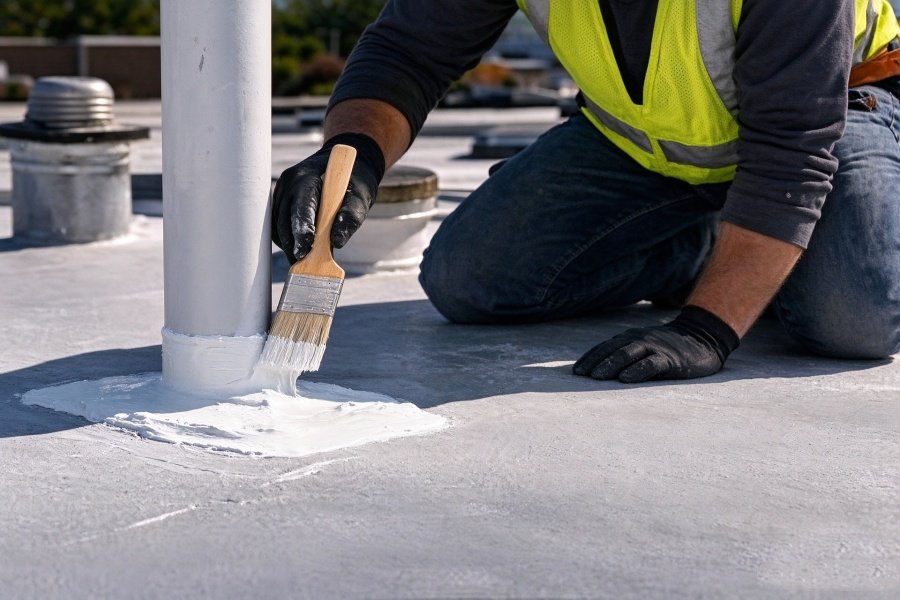
Complex Geometric Detailing & Penetration Reinforcement
HVAC conduit clusters, structural columns, pipe flashings, and internal corners are the primary failure points in building envelopes. CHEMPU liquid applied systems are engineered to create a flexible, seamless joint transition:
- Step 1 Substrate Preparation: Grind concrete to ICRI CSP 2-3 profile and apply substrate-matched primer (epoxy or polyurethane).
- Step 2 Joint Detailing: Fill corner fillets with CHEMPU PU sealant and embed non-woven polyester fabric into a wet basecoat.
- Step 3 Topcoat Application: Apply continuous body and topcoat passes to achieve specified 1.5 - 2.0 mm dry film thickness.
| Target Engineering Location | Dominant Substrates | Recommended Membrane Formulation | Specified Dry Film Thickness (DFT) | Primer & Reinforcement System |
|---|---|---|---|---|
| Underground Basements & Foundations | Poured Concrete, Precast Panels | CHEMPU WP-001 (Pure PU) | 1.5 mm - 2.0 mm | Epoxy Primer + Polyester scrim at corners |
| Parking Decks & High-Wear Podiums | Heavy Concrete, Steel Decks | CHEMPU XYT-P101 (Deck PU) | 2.0 mm - 2.5 mm | PU Penetrating Primer + Quartz aggregate broadcast |
| Balconies, Wet Rooms & Tile Remediation | Old Ceramic Tile, Cement Screed | CHEMPU XYT-S001 (MS Hybrid) | 1.2 mm - 1.5 mm | Primerless on sound tile / PU sealant at perimeter |
| Exposed Commercial Flat Roofs | Concrete Deck, Weathered Bitumen | CHEMPU WP-001 + UV Topcoat | 1.5 mm - 2.0 mm | Bitumen Primer + Aliphatic UV protective barrier |
| Metal Roofs & Industrial Cladding | Corrugated Galvanized Iron, Aluminum | CHEMPU WA-100 (Acrylic Roof) | 1.0 mm - 1.2 mm | Anti-corrosion wash primer + Stitch-bonded fleece |
International Quality Standards & Testing Benchmarks for Liquid Membranes
Civil engineering consultants and municipal general contractors require verifiable proof of physical durability. Every CHEMPU formulation is tested and qualified against premier global testing methodologies.

Bulk Container Supply with Complete Traceability
Operating an annual output exceeding 30,000 metric tons, CHEMPU provides direct-from-factory export shipments to North America, Latin America, Southeast Asia, and the Middle East:
- Global Standard Certification: ISO 9001:2015 quality management and ISO 14001 environmental safety compliance.
- Rigorous Testing: Third-party verified laboratory test reports according to ASTM C836, ASTM C957, and ASTM D6083.
- Export Packaging: Palletized 20kg UN metal pails and 230kg steel industrial drums with custom private OEM/ODM labeling.
ASTM C836
Standard specification for high solids content, cold liquid-applied elastomeric waterproofing membrane for use with separate wearing course. Governs WP-001 certification.
ASTM C957
Standard specification for high-solids-content, cold liquid-applied elastomeric waterproofing membrane with integral wearing surface for vehicular parking decks. Governs XYT-P101.
ASTM D6083
Standard specification for liquid applied acrylic coating used in roofing. Verifies tensile strength, elongation recovery, low-temperature flexibility, and accelerated weathering of WA-100.
ISO 11890-2 & Low VOC
Stringent gas chromatography determination of volatile organic compounds (VOC). Guarantees eco-friendly compliance for sensitive indoor wet areas and green building rating systems.
Liquid Waterproofing Membrane Technical FAQ & Project Sourcing
Clear technical answers regarding design service life, application criteria, material consumption calculations, and international export logistics.
Depending on the chemical formulation and dry film thickness (DFT), CHEMPU liquid applied membrane systems provide a design service life ranging from 15 to 25+ years. Polyurethane and MS hybrid polymer systems typically deliver 20 to 25 years of continuous waterproofing under buried or UV-protected conditions, while high-grade acrylic roof coatings deliver 10 to 15 years with easy recoatability.
Material consumption depends on target dry film thickness (DFT) and product solid content. For example, achieving a 1.5 mm DFT with our WP-001 (solid content ≥ 85%) requires approximately 1.8 to 2.0 kg/m² across two coats. For an 8,000 m² basement podium, total consumption is approximately 15 to 16 metric tons. Our engineering team provides precise project material takeoffs upon receiving architectural drawings.
Standard polyurethane membranes require dry concrete substrates with moisture content ≤ 8% and ambient temperatures between 5°C and 35°C. For damp or emergency rainy-season applications, CHEMPU XYT-S001 MS Polymer can be applied on damp concrete with up to 15% moisture content without blistering or adhesion failure.
Liquid membranes excel at complex detailing. Penetrations and dynamic joints are detailed using a hybrid detail protocol: joints are first filled with CHEMPU PU sealant, reinforced with non-woven polyester or fiberglass scrim cloth, and encapsulated with 2 to 3 coats of liquid membrane, creating an unbroken elastomeric seal that moves with the structure.
CHEMPU offers 20 kg UN-certified steel pails (36 pails per pallet / 720 kg) and 230 kg heavy-duty industrial drums (4 drums per pallet / 920 kg). A standard 20ft export container accommodates up to 14.4 metric tons (palletized) or 18 metric tons (floor-loaded), shrink-wrapped with waterproof export packing.
Request Factory-Direct Pricing & TDS
Direct response from CHEMPU waterproofing coating engineers within 2 business hours. Complete technical documentation and custom formulation support.