Waterproof Traffic Coating for Parking Decks & Garages
CHEMPU engineered waterproof traffic coating is a heavy-duty, elastomeric polyurethane vehicular deck membrane system designed to protect multi-story parking garages, drive ramps, and elevated parking decks against continuous vehicle tire friction, structural vibration, motor oil contamination, and deicing salt attack. Combining Shore A 60 hardness with 7 MPa tensile strength, it delivers seamless monolithic waterproofing that dynamically bridges live concrete cracks up to 2.5 mm.
7 ± 1 MPa Tensile Strength
Dynamic Crack Bridging >2.5 mm
ASTM C957 Compliant
Heavy Rolling Wheel Load Rated
Traffic Deck Engineering Requirements by Operating Scenario
Vehicular traffic surfaces encounter severe mechanical stress, live structural deflection, and corrosive environmental exposure. Selecting the appropriate coating thickness, aggregate mesh, and resin chemistry requires matching traffic volume, wheel loads, and slab conditions:
| Operating Scenario & Location | Vehicle Class & Load Rating | Substrate Deflection & Crack Profile | Drainage Pitch & Ponding Risk | Recommended Wear Layer Build | Surface Texture & Slip Rating |
|---|---|---|---|---|---|
| Parking Garage Intermediate Decks | Light Passenger Cars (Class 1-2, <3.5 Tonnes) | Moderate vibration; static & dynamic cracks <1.5 mm | Min. 1.5% fall to scupper drains; minimal ponding | Standard System 1.5–1.8 mm PU Build | Medium Quartz (PTV ≥40 Wet) |
| Steep Vehicular Access Ramps (>10% Slope) | Heavy Passenger & Delivery Vans (Tire Shear Forces) | High dynamic torque, acceleration shear, joint flexure | Rapid gravity runoff; zero ponding risk | Heavy Duty 2.2–2.5 mm High-Build PU | Coarse Bauxite / Quartz (PTV ≥55 Wet) |
| Rooftop Parking Decks (Exposed Sunlight) | Passenger Cars, SUVs & Maintenance Vehicles | Extreme thermal shock cycling (-30°C to +75°C); cracks >2.0 mm | Variable drainage; ponding risk in structural deflections | UV-Stable Aliphatic 2.0 mm PU + Aliphatic TC | Encapsulated Quartz (PTV ≥45 Wet) |
| Underground Lower-Level Slabs (On-Grade) | Vehicles, Facility Shuttles, Floor Scrubbers | Negative hydrostatic vapor pressure; hairline settlement | Sump pump collection; persistent high humidity | Vapor-Barrier Primer + 1.5 mm PU Membrane | Medium Anti-Skid Quartz (PTV ≥40 Wet) |
| Tight Radius Turning Bays & Spiral Helixes | Power Steering High-Torsion Turning Loads | Severe localized horizontal scuffing and tearing stress | Standard slope to drainage perimeter | Double Wear Course 2.5 mm PU System | High-Hardness Broadcast (PTV ≥50 Wet) |
| Ticket Booths, Gates & Toll Plazas | Repetitive Stop-and-Go Braking Impact | Point-load compression and fuel/oil drip concentration | Flat curb transitions; localized moisture collection | Reinforced Hybrid 2.2 mm PU + Sealant Bands | Dense Anti-Slip Aggregate (PTV ≥45 Wet) |
| Commercial Loading Docks & Delivery Bays | Medium-to-Heavy Trucks (Class 6-8, Axle Loads >8 Tonnes) | Substantial slab joint displacement and edge spalling | Direct exterior apron drainage to trench drains | Industrial Armor 3.0 mm Multi-Coat Build | Aluminium Oxide / Bauxite (PTV ≥60 Wet) |
System Configuration & Model Specifications
Engineered traffic coating waterproofing requires an integrated multi-coat assembly where penetrating adhesion, high-elongation waterproofing, and high-tensile aggregate retention act as a unified structural envelope. Review our tested system configurations:
CHEMPU EP-Primer (Moisture-Tolerant Base)
Two-component, low-viscosity epoxy primer engineered to deeply penetrate concrete pores, consolidate weak laitance, seal capillary moisture up to 5% substrate moisture content, and establish an unshakeable chemical bond (>2.5 MPa pull-off adhesion).
- Solids: 100% Solvent-Free Reactive
- Coverage: 0.20–0.25 kg/m² per coat
- Bond Strength: >2.5 MPa (Concrete failure)
CHEMPU XYT-P101 (Heavy-Duty Traffic PU)
Core high-performance elastomeric polyurethane membrane. Formulated for heavy vehicular rolling loads, balancing Shore A 60 ± 5 toughness with >350% elongation. Learn more in our XYT-P101 high-strength PU membrane specs for complete technical parameters.
- Tensile: 7.0 ± 1.0 MPa (ASTM D412)
- Crack Bridging: >2.5 mm Dynamic (ASTM C1305)
- Hardness: Shore A 60 ± 5 (ASTM D2240)
Aggregate Broadcast & Topcoat (Wear Layer)
Kiln-dried, washed graded quartz silica (0.4–0.8 mm) or calcined bauxite broadcast to refusal, locked in with an aliphatic UV-stable polyurethane topcoat (TC-200) to deliver non-slip tire traction and complete chemical fluid resistance.
- Aggregate: 40–70 Mesh Quartz or Bauxite
- Topcoat: Aliphatic PU (Non-yellowing)
- Slip Index: BPT Wet >45 PTV / COF >0.65
Master Specification Matrix: Heavy-Duty PU vs. Conventional Systems
A comprehensive side-by-side engineering evaluation contrasting CHEMPU XYT-P101 heavy-duty polyurethane traffic coating against conventional rigid epoxy floorings and single-pack elastomeric deck coatings:
| Engineering Property / Standard | CHEMPU XYT-P101 Polyurethane Traffic System | Standard Rigid Epoxy Floor Coating | Conventional Single-Pack Deck Coating |
|---|---|---|---|
| Chemical Base Polymer | High-Tensile Moisture/Chemical Cured Polyurethane | 100% Solids Bisphenol-A Epoxy Resin | Water-Based Pure Acrylic Terpolymer |
| Solids Content by Weight (%) | ≥98% High Solids, Low VOC Formulation | ≥98% Solvent-Free Epoxy | 60% ± 3% Waterborne Dispersion |
| Shore Hardness (ASTM D2240) | Shore A 60 ± 5 (Elastomeric Tough) | Shore D 80 ± 5 (Brittle Rigid) | Shore A 45 ± 5 (Soft Flexible) |
| Tensile Strength (ASTM D412) | 7.0 ± 1.0 MPa (High Puncture & Shear Resistance) | 25.0 ± 3.0 MPa (High Compressive, Low Shear) | 2.0 ± 0.5 MPa (Low Mechanical Strength) |
| Elongation at Break (ASTM D412) | >350% (Dynamic Crack-Bridging Elasticity) | <5% (Zero Flexural Ductility) | >300% (High Stretch, Low Recovery) |
| Dynamic Crack Bridging (ASTM C1305) | Bridges >2.5 mm dynamic cracks at -10°C | Fails at <0.2 mm hairline micro-cracks | Bridges 1.0 mm static cracks only |
| Taber Abrasion (ASTM D4060, CS-17 1000g/1000 revs) | <45 mg weight loss (Exceptional Tire Wear Life) | <35 mg weight loss (Good until cracked) | >160 mg weight loss (Rapid erosion under wheels) |
| Concrete Adhesion Pull-Off (ASTM D4541) | >2.5 MPa (100% Concrete Cohesive Failure) | >2.8 MPa (Cohesive Concrete Failure) | >1.2 MPa (Substrate Interfacial Failure) |
| Low-Temperature Flexibility (ASTM C836) | Passes -30°C Mandrel Bend without cracking | Severely brittle below 0°C; micro-shatters | Passes -15°C Mandrel Bend |
| Freeze-Thaw Durability (50 Thermal Cycles) | Zero blistering, delamination, or loss of adhesion | Frequent spalling over damp concrete joints | Surface chalking and pinhole micro-blistering |
| Automotive Chemical Fluid Resistance | Resistant to motor oils, brake fluid, glycol & deicing salts | Resistant to fuels; vulnerable to thermal shock | Vulnerable to motor oil softening & brake fluid |
| Impact Resistance (ASTM D2794, Direct) | >160 in-lbs (Elastic energy dissipation) | <40 in-lbs (Chipping & radial cracking) | >100 in-lbs (Soft deformation) |
| Tack-Free Dry Time (25°C, 50% RH) | 60 to 90 minutes per layer | 4 to 8 hours | 60 to 120 minutes |
| Full Vehicular Traffic Reopen Time | 48 to 72 hours (Rapid commercial turnover) | 72 to 96 hours | Unrated for heavy vehicular wheel traffic |
| UV Weathering Stability (QUV 1000 Hours) | Excellent with aliphatic topcoat; zero chalking | Severe yellowing, chalking, and surface hazing | Good UV resistance, poor abrasion durability |
| VOC Emission Rating | <25 g/L (Ultra-low VOC compliant) | <50 g/L (Low VOC) | <30 g/L (Low VOC) |
| Primary Civil & Commercial Application | Multi-story parking decks, spiral ramps, loading bays | Interior dry warehouses, factory production floors | Residential balconies, pedestrian footpaths |
Dynamic Crack Bridging & Load Dissipation Mechanics
Why rigid floorings crack under vehicular traffic and how elastomeric polyurethane membranes maintain an unbroken waterproof seal under heavy dynamic rolling axle loads:
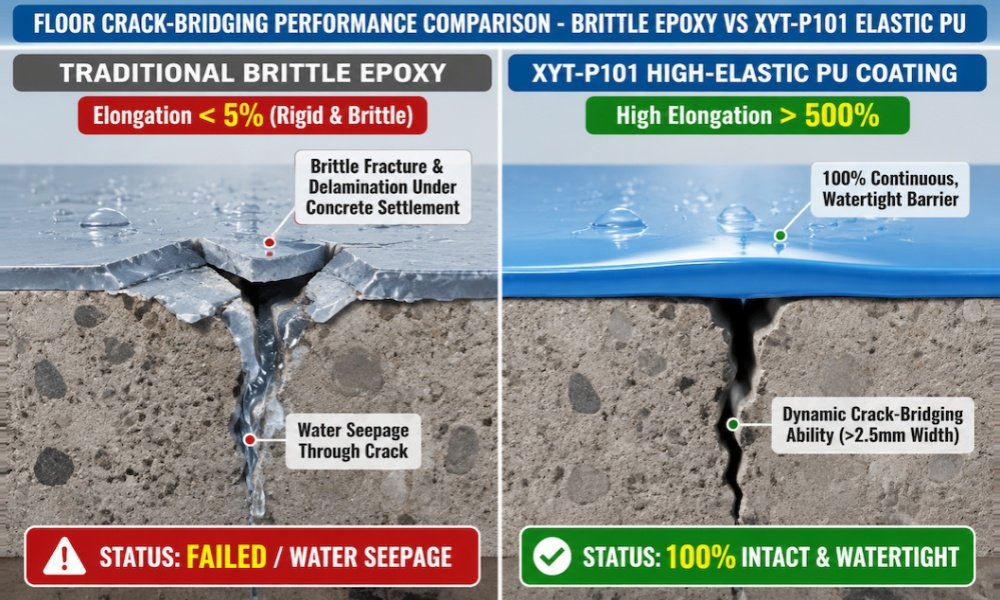
Structural Mechanics: Polyurethane vs. Rigid Epoxy
In elevated concrete parking structures, slabs constantly undergo flexural deflection, live vibrational oscillations from moving vehicles, and daily thermal expansion. Under this dynamic cyclic stress, rigid epoxy coatings (tensile elongation <5%) cannot deform with concrete joint movements. As micro-cracks form in the substrate, rigid epoxy concentrates stress directly at the crack apex, causing immediate brittle fracture, moisture ingress, and accelerated rebar corrosion.
In contrast, CHEMPU XYT-P101 combines Shore A 60 ± 5 hardness with a 7 ± 1 MPa tensile matrix and >350% elongation. The membrane acts as an elastomeric stress-relieving spring that absorbs vertical rolling tire loads while flexing horizontally over substrate fissures.
At a nominal dry film thickness (DFT) of 1.5 mm and an elastic recovery strain of 180%, XYT-P101 reliably bridges dynamic joint movements up to 2.7 mm (>100 mils) without rupture, validated under continuous ASTM C1305 cyclic movement testing down to -10°C.
5-Step Vehicular Deck Installation & Detailing SOP
Strict adherence to surface profiling, joint reinforcement, and staged aggregate encapsulation guarantees a 15+ year maintenance-free service life under intense commercial traffic:
Surface Profiling & Crack Routing
Shot-blast or diamond-grind concrete to ICRI CSP 3–4 profile. Route all cracks wider than 0.5 mm to 10×10 mm grooves and fill flush with CHEMPU PU elastomeric sealant. Verify moisture <5%.
Epoxy Penetrating Primer
Roll CHEMPU EP-Primer at 0.20–0.25 kg/m². Completely seal concrete capillary pores to prevent outgassing pinholes and achieve a chemical anchor bond exceeding 2.5 MPa into the substrate.
Elastomeric Base Membrane
Apply first coat of CHEMPU XYT-P101 at 1.0–1.2 kg/m² using a notched squeegee. Cure for 4–6 hours to establish the primary seamless waterproof and dynamic crack-bridging membrane barrier.
Aggregate Broadcast Wear Coat
Apply intermediate wear coat of XYT-P101 at 0.8 kg/m². Immediately broadcast kiln-dried graded silica quartz (0.4–0.8 mm) or calcined bauxite to full excess saturation (~3.0 kg/m²).
Aliphatic Seal & Staged Reopen
Sweep excess sand and apply aliphatic UV topcoat (TC-200) at 0.35–0.45 kg/m². Follow staged opening timeline: foot traffic in 24 hours; passenger cars in 48–72 hours; heavy trucks in 7 days.

Architectural Detailing at Expansion Joints & Ramps
Vehicular parking structures fail most frequently at structural expansion joints and drainage perimeter gutters where differential thermal and dynamic movements concentrate.
Under CHEMPU specification standards, expansion joints must incorporate a multi-tiered defense: an elastomeric expansion loop membrane reinforced with high-modulus polyester scrim, backed by a closed-cell Ethafoam rod and heavy-duty traffic-rated joint sealant. At perimeter drainage channels, the XYT-P101 membrane is fully dressed into the throat of the drain basin with an integrated clamp ring to eliminate lateral water tracking.
Commercial Multi-Story Parking Garage Restoration Case
A real-world engineering project overview demonstrating how CHEMPU heavy-duty polyurethane traffic coatings resolve severe water seepage and concrete spalling across high-capacity parking decks.
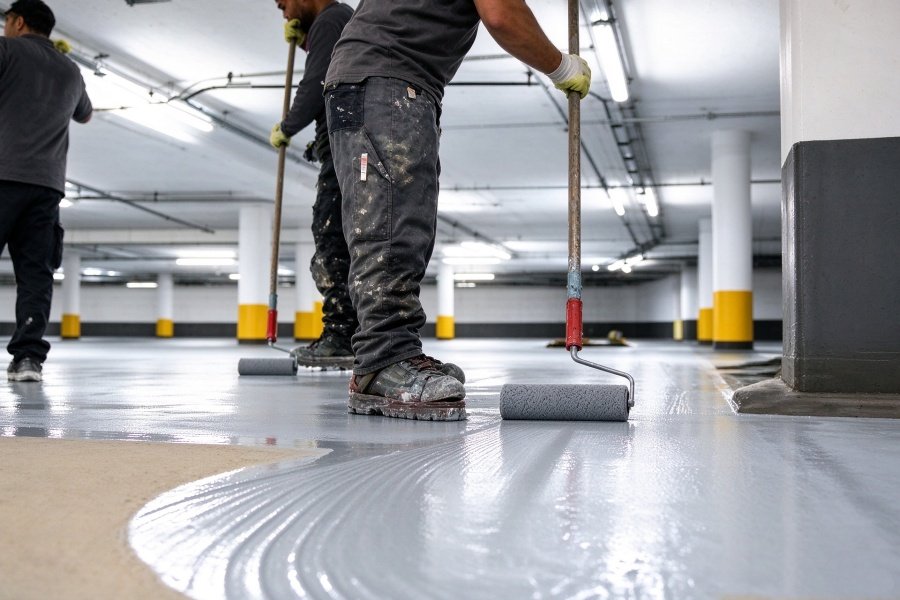
Urban Transit Hub Multi-Deck Structure Remediation
Structural Challenge: An elevated 4-level commercial parking facility experienced widespread water and deicing salt penetration through dynamic slab flexure cracks. Leaking brine severely corroded post-tensioned structural rebar and damaged customer vehicles parked on lower levels, while high tire shear forces on access ramps had stripped prior thin epoxy coatings.
Engineering Solution: The facility team selected the CHEMPU XYT-P101 Heavy-Duty Vehicular System. Contractors mechanically prepared the slab via captive shot-blasting to CSP 3, repaired dynamic joints with high-elasticity PU sealant, and squeegee-applied a 2.2 mm multi-coat build incorporating broadcast kiln-dried quartz aggregate and an aliphatic chemical-resistant topcoat.
Delivery Performance: Over 18 months of continuous commercial operations, periodic ultrasonic testing and visual inspection confirmed zero moisture seepage into retail spaces below, intact crack bridging over live vibration joints, and high wet skid resistance across all turning bays and entrance ramps.
Total multi-story deck area waterproofed with heavy-duty PU traffic membrane.
Staged section handover to passenger vehicular traffic without facility shutdown.
100% moisture containment verified across active dynamic expansion joints.
Frequently Asked Questions on Waterproof Traffic Coatings
Direct engineering answers to common procurement, design, and contractor installation questions:
Request Waterproof Traffic Coating Specification
Direct factory technical support & export pricing within 24 hours