Waterproof Roof Coating Systems (Flat / Metal / Tiled)
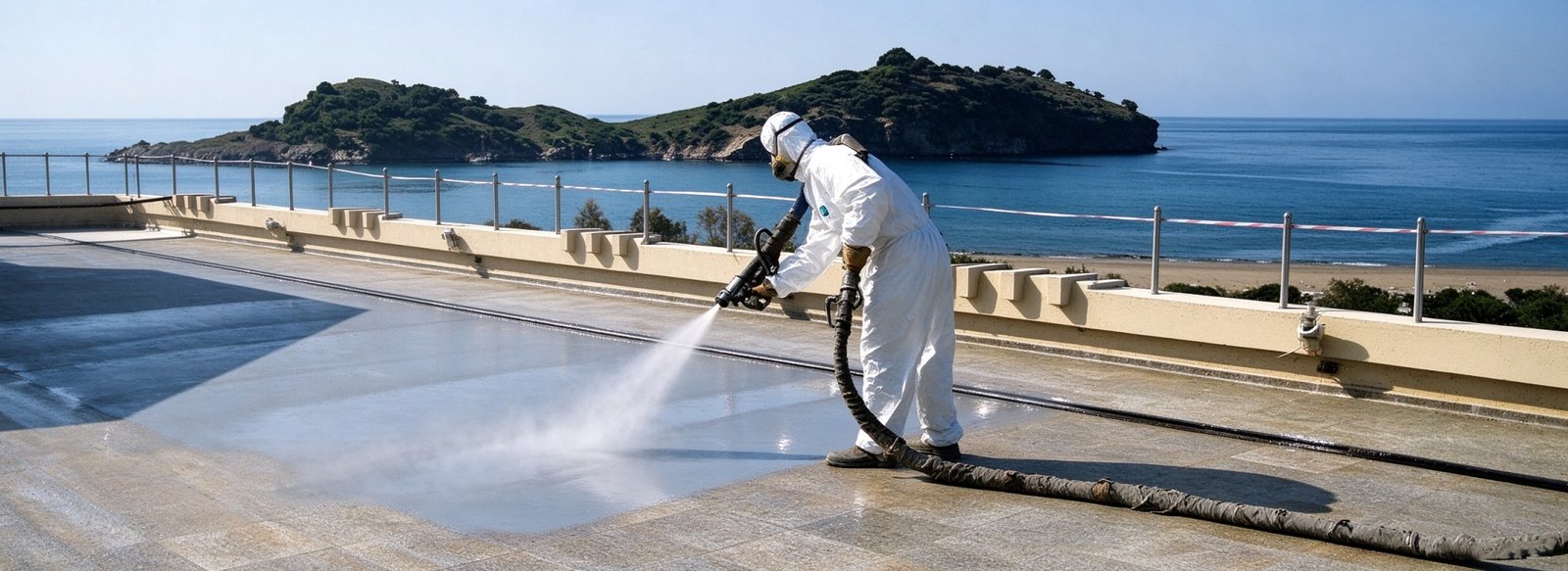
A complete roof waterproofing system from substrate assessment to UV-protected finish, configured around your roof type and traffic load. CHEMPU waterproof roof coating technology forms a fully adhered, monolithic barrier that stops leaks across aging flat decks, corrugated metal sheets, and mineral-surfaced bitumen without expensive tear-offs.
Flat, Metal & Tiled Substrates
>300% Crack-Bridging Elongation
Solar Heat Reflectance (SRI >100)
ASTM D6083 & ISO 11890-2
Roof Substrate & Environmental Loading Criteria
Selecting an effective liquid applied roof membrane requires calculating structural slope, thermal expansion movement, dynamic traffic load, and ponding water exposure.
| Roof Substrate Type | Pitch / Slope Range | Traffic Load Level | Joint Movement Capacity | UV & Ponding Exposure | Recommended System Strategy |
|---|---|---|---|---|---|
| Flat Concrete Decks | 0° to 2° (Dead flat to positive pitch) | Maintenance & Pedestrian Traffic | High (±25% structural joint expansion) | Zero-slope ponding water & direct solar radiation | Polyurethane / Acrylic Multi-Coat with reinforced expansion joints |
| Corrugated Metal Roofs | 2° to 15° (Low to steep commercial slope) | Occasional HVAC maintenance access | Extreme (±35% thermal expansion across seams) | High UV, thermal shock & fastener screw shear | Elastomeric Acrylic + Polyester Mesh over rust-inhibited seams |
| Aged Bitumen & Torch-on Sheets | 0.5° to 3° (Low slope industrial roofs) | Maintenance personnel access | Moderate to High (±20% inter-ply movement) | Severe UV degradation & alligatoring lap joints | P101 Elastic Base + Aliphatic Topcoat fully encapsulating sheets |
| Pitched Clay & Concrete Tile Roofs | 10° to 45° (Steep residential/commercial pitch) | Light maintenance only | Low to Moderate (±15% ridge movement) | High wind-driven rain & solar thermal cycling | Breathable Acrylic Elastomeric Barrier with ridge mortar sealing |
| Commercial Parapets & Drains | 90° Vertical transitions & sumps | Non-traffic perimeter detail | High stress (±30% wall-to-deck differential) | Continuous localized standing water immersion | Heavy-Duty Mesh Reinforcement with zero-VOC MS/PU hybrid |
| Rooftop Plant & Chiller Decks | 1° to 3° Positive drainage slope | Heavy foot traffic & equipment vibration | High continuous dynamic cyclic stress | Ozone, lubricating oils, vibration & standing water | High-Tensile PU Traffic System with anti-slip quartz broadcast |
Factory-Engineered Coating Configurations for Commercial Roofs
Match your specific roof geometry and exposure conditions to CHEMPU’s factory-tested fluid membrane formulations.
| Application Scenario | Primary Formulation Base | Coating Build & Layers | Dry Film Thickness | Core Technical Advantage | Detailed Product Specifications |
|---|---|---|---|---|---|
| Flat Roof Renovation & Over-coating | WA-100 High-Elastic Waterborne Acrylic | 1x Primer + 2x Self-Leveling Coats | 1.0 mm – 1.2 mm DFT | Self-leveling monolithic skin, >300% elasticity, micro-porous breathable finish | WA-100 self-leveling roof coating specs |
| High-UV Exposed & Extreme Weather Finishes | XYT-S001 Solvent-Free Modified Silane (MS) | 1x Tie-Coat + 2x High-Build Coats | 1.2 mm – 1.5 mm DFT | Permanent non-yellowing UV stability, zero VOC, immediate rain-washout immunity | XYT-S001 UV-stable roof finish specs |
| Aged Bitumen & Crack-Bridging Heavy Traffic | XYT-P101 High-Strength Pure Polyurethane | 1x Epoxy Primer + 2x Pure PU Layers | 1.5 mm – 2.0 mm DFT | >6.0 MPa tensile strength, >450% elongation, withstands continuous water ponding | XYT-P101 crack-bridging roof membrane specs |
| Corrugated Metal Roof Seam & Fastener Restoration | WA-100 System + Polyester Stitch-Bond Mesh | Inhibitive Primer + Mastic + 2x Coats | 1.2 mm Reinforced DFT | Thermal movement tolerance ±35%, anti-rust passivating barrier, heat rejection | WA-100 self-leveling roof coating specs |
| High-Performance Commercial PU Roof System | PU System: P101 Base + Aliphatic Protective Top | Epoxy Primer + P101 Membrane + UV Top | 1.5 mm – 1.8 mm DFT | Multi-layer chemical resistance, severe climate stability, complete seamless envelope | polyurethane waterproof coating range from CHEMPU |
Master Specification Comparison: Liquid Applied Roof Membrane vs Sheet Systems
Compare CHEMPU liquid applied roofing membrane configurations directly against conventional torch-applied bitumen and single-ply sheets across 15 audited physical metrics.
| Engineering Metric | CHEMPU WA-100 Acrylic | CHEMPU XYT-S001 MS Hybrid | CHEMPU XYT-P101 Pure PU | Traditional Bitumen / Sheet |
|---|---|---|---|---|
| 1. Chemical Polymer Base | 100% High-Solid Elastomeric Acrylic | Solvent-Free Silyl-Modified Polymer | 100% Single-Component Polyurethane | Oxidized Asphalt / SBS Sheet |
| 2. Solids Content by Volume (%) | ≥68% High Solids | ≥98% Ultra-High Solids | ≥85% Moisture-Cure Solids | N/A (Solid sheet roll) |
| 3. Tensile Strength (ASTM D412) | ≥2.4 MPa | ≥3.2 MPa | ≥6.5 MPa | ≥1.8 MPa (Seams vulnerable) |
| 4. Elongation at Break (ASTM D412) | ≥350% (Dynamic flexibility) | ≥420% (Elastic recovery) | ≥480% (Extreme bridging) | ≤40% (Susceptible to cracking) |
| 5. Seam & Joint Integrity | 100% Monolithic (0 Seams) | 100% Monolithic (0 Seams) | 100% Monolithic (0 Seams) | Seam lap failure risk every 1 meter |
| 6. Surface Dry & Recoat Time (25°C) | Surface dry 2h | Recoat 4h | Surface dry 1.5h | Recoat 3h | Surface dry 4h | Recoat 8h | Torch heat or chemical adhesive |
| 7. Volatile Organic Content (VOC) | <15 g/L (Waterborne ultra-low) | 0 g/L (100% Solvent-free) | <50 g/L (SCAQMD Rule 1113) | High asphalt fume & burn hazard |
| 8. Permanent Ponding Water Resistance | Good (Standard positive drainage) | Excellent (Zero swelling) | Superior (Continuous immersion) | Poor (Lap moisture creep & rot) |
| 9. Solar Reflectance Index (SRI) | ≥104 (Brilliant White Cool Roof) | ≥102 (Aliphatic Bright White) | ≥98 (Solar reflective topcoat) | ≤25 (Heat-absorbing dark black) |
| 10. Service Temperature Range | -25°C to +85°C | -40°C to +95°C | -35°C to +90°C | -10°C to +60°C (Brittle in winter) |
| 11. Low-Temperature Flexibility | Passes -20°C mandrel bend | Passes -30°C mandrel bend | Passes -30°C mandrel bend | Fails below -5°C (Cracks) |
| 12. Penetrability & Flashing Ease | Fluid conforms to all shapes | High-thixotropic fluid detailing | Brush/roller uniform detailing | Requires cutting, splicing & torching |
| 13. Fire Resistance Rating | Class A Fire Retardant (ASTM E108) | Class A Self-Extinguishing | Class B Flame Resistant | Class C / Open-flame fire risk |
| 14. Service Life Expectancy | 10 to 12 Years (Renewable) | 15+ Years (Renewable) | 15+ Years (Renewable) | 5 to 8 Years before seam failure |
| 15. Packaging & Drum Supply | 5 kg & 18 kg Sealed Pails | 5 kg, 20 kg & 200 kg Drums | 20 kg Metal Pails & 200 kg Drums | Heavy rolls (40 kg/roll) |
Engineering Takeaway: Unlike mechanical sheet systems that introduce over 1,500 linear meters of failure-prone lap joints on a typical 1,000 m² commercial roof, liquid applied roofing membrane systems wrap the entire building in a seamless protective envelope. CHEMPU roof waterproofing coating products eliminate water tracking under membranes and provide high solar reflectance that significantly lowers building cooling loads.
Elastomeric Acrylic vs Polyurethane vs MS Polymer Chemistry
Understanding polymer mechanics ensures you select the correct roof waterproof coating formulation for your climate, traffic requirements, and budget.
Elastomeric Acrylic Resins
Waterborne acrylic formulations deliver unmatched solar reflectivity, superior vapor permeability, and ease of water clean-up. By breathing water vapor outward while blocking liquid ingress, acrylic elastomeric coatings eliminate blistering on porous concrete decks and provide the lowest cost per square meter for large-scale warehouse cool roofs.
Polyurethane Polymers (PU)
Moisture-curing polyurethane resins provide the highest mechanical tensile strength (>6.0 MPa) and unmatched resistance to continuous ponding water. Polyurethane coats form a dense, thermoset elastomer that withstands foot traffic, mechanical equipment vibration, and harsh industrial chemical washdowns without softening or micro-swelling.
Silyl-Modified Polymers (MS)
MS silane hybrids combine the permanent UV stability of silicones with the high tear strength and paintability of polyurethanes. Being 100% solvent-free and isocyanate-free, MS coatings cure bubble-free in humid climates, remain flexible down to -40°C, and will not wash off even if rain begins immediately following application.

Engineered Waterproof Metal Roof Coating Systems
Commercial standing-seam and corrugated metal roofs undergo extreme thermal cycling, expanding and contracting up to 15 mm between day and night. Traditional sealants shear away within two years, leading to fastener backing-out, seam gaps, and severe rust penetration across structural purlins.
CHEMPU’s specialized waterproof metal roof coating system incorporates a three-phase approach: passivating rust conversion with an inhibitive primer, encapsulating all fasteners and horizontal lap seams with polyester stitch-bonded fabric and mastic, and applying two coats of WA-100 elastomeric acrylic coating. This forms a flexible, solar-reflective membrane that moves elastically with metal expansion cycles while lowering interior building temperatures by up to 8°C.

PU Roof System: Commercial Polyurethane Waterproof Coating for Roofs
Zero-slope flat roofs with structural deflection are routinely subjected to standing water (ponding) that hydrolyzes conventional waterborne coatings. For long-term protection, engineers specify a multi-layer polyurethane waterproof coating for roof assets subjected to continuous hydraulic pressure.
The CHEMPU commercial PU roof system combines a deep-penetrating polyurethane primer, a 1.2 mm elastomeric basecoat of XYT-P101 pure polyurethane providing >450% elongation, and a weather-resistant aliphatic topcoat that prevents UV chalking. The resulting monolithic skin resists root penetration, ponding water, and aggressive rooftop emissions.
5-Step Standard Operating Procedure for Roof Coating Application
Strict compliance with substrate prep, detailing, and multi-pass cross-coating guarantees a 15-year watertight commercial envelope.
Surface Inspection & Cleaning
Power-wash substrate at ≥2,500 psi. Remove oils, algae, and loose particles. Substrate moisture content must test <8% by pin meter before proceeding.
Critical Joint & Flashing Detailing
Reinforce all parapet flashings, internal drains, skylight curbs, and pipe penetrations using stitch-bonded polyester fabric embedded in fluid elastomeric mastic.
Primer Application
Apply substrate-matched primer (epoxy for concrete/asphalt, anti-corrosive primer for steel) at 0.15–0.20 kg/m² to seal pores and maximize interfacial pull-off adhesion.
Multi-Pass Cross Coating
Apply 2 to 3 fluid coats in contrasting colors (e.g., grey base, white finish) using roller or airless spray. Ensure 90° perpendicular cross-passes to avoid pinholes.
DFT Verification & QC Handover
Verify dry film thickness (DFT ≥ 1.0–1.5 mm) with ultrasonic gauge. Conduct 24-hour water ponding test around drains prior to issuing factory warranty certificate.
10-Year ROI: Liquid Roof Restoration vs Complete Tear-Off Re-Roofing
Evaluating capital expenditure, disposal fees, and commercial facility disruption for a standard 1,000 m² (approx. 10,000 sq.ft.) commercial facility.
- Demolition & Disposal Costs: $22,000 – $35,000 (Tipping fees for hazardous asphalt/sheeting)
- New Insulation & TPO/EPDM Installation: $65,000 – $90,000
- Business Downtime & Dust Disruption: 14 to 21 working days (Severe indoor tenant impact)
- Total Estimated Capital Outlay: $87,000 – $125,000
- Lifecycle Status at Year 10: Mechanical lap seams begin failing; requires replacement cycle.
- Demolition & Landfill Fees: $0 (Zero waste; old roof retained as thermal base)
- Substrate Prep, Seam Detailing & Fluid Coating: $28,000 – $38,000
- Business Disruption: Zero facility downtime (Fast non-invasive application)
- Cool Roof Energy Savings (SRI >100): $1,800 – $2,500/year HVAC power reduction
- Total Net 10-Year Cost: $12,000 – $20,000 (Net after electricity savings)
- Capital Savings: >65% Total Cost Reduction; easily refreshed with 1 topcoat at Year 10.
Case Study: 12,500 m² Industrial Warehouse Roof Restoration
Real-world commercial logistics center restoration eliminating chronic fastener leaks and lowering building cooling load.
A major logistics hub experienced active roof leaks across 180+ corrugated metal end-laps and corroded screw fasteners. The owner faced quotes exceeding $450,000 for metal sheet replacement, which would require shutting down warehouse fulfillment lines for 30 days.
CHEMPU deployed the WA-100 Elastomeric Waterproof Roof Coating System: wire-brushing corroded seams, priming with anti-rust passivator, stitch-bonded fabric encapsulation of all fasteners, and two spray coats of high-solids white WA-100 at 1.2 mm DFT.
Zero operational downtime. Surface temperature dropped by 14.8°C, reducing summer chiller electricity usage by 18.2%. Total project cost was 62% below the sheet replacement estimate.
Looking for comprehensive engineering comparisons? Read our technical guide on best roof waterproof coating options across commercial substrates.
Frequently Asked Questions on Waterproof Roof Coatings
Direct engineering answers to common procurement, design, and installation questions.
Yes, liquid applied roof membrane systems provide exceptional waterproofing and thermal protection on commercial metal roofs. Prior to application, surface rust must be wire-brushed or treated with an anti-corrosion primer, and all standing seams, fastener heads, and end laps must be reinforced with elastomeric mastic and polyester stitch-bonded fabric. Once cured, the fluid membrane forms a continuous seamless skin that accommodates heavy thermal movement (±35%) without shearing.
A professional roof waterproofing coating restoration is generally superior when the existing roof insulation is dry and structurally sound. Applying a seamless fluid coating eliminates 100% of mechanical seams and penetrations, saves 50% to 70% in capital costs, avoids landfill tear-off fees, and causes zero operational downtime inside commercial facilities. However, if more than 25% of the underlying insulation is saturated with moisture, localized moisture extraction or partial replacement is necessary before coating.
Commercial waterproof roof coatings should be formally inspected twice per year—typically in early spring and late autumn—as well as immediately following severe hail storms or hurricane-force winds. Inspections should verify that scuppers, roof drains, and gutters remain free of debris and that rooftop mechanical maintenance personnel have not punctured the cured elastomeric membrane. Any accidental physical punctures can be repaired in minutes using fluid brush-applied touch-up coating.
The minimum recommended substrate and ambient temperature for applying roof waterproof coating systems is 5°C (41°F) and rising, with a maximum allowable temperature of 35°C (95°F). Furthermore, the roof surface temperature must be at least 3°C (5°F) above the ambient dew point to prevent condensation from undermining coating adhesion. Avoid applying waterborne acrylic coatings if rain or frost is forecasted within 24 hours of application.
Yes, CHEMPU roof coatings can be directly applied over aged modified bitumen, smooth asphalt, weathered EPDM, and weathered PVC/TPO sheet membranes. The existing substrate must be thoroughly power-washed, fully dried, and all blistered or unadhered sheet laps must be mechanically repaired before coating. Specific adhesion primers (such as CHEMPU universal asphalt tie-coat) are utilized to guarantee chemical bonding between the aged sheet and the new fluid membrane.
A properly installed CHEMPU multi-coat system delivers a continuous service life of 10 to 15 years depending on the dry film thickness (DFT) applied. Because the elastomeric coating is fully compatible with maintenance recoating, applying a fresh topcoat at the 10-year mark extends commercial waterproofing reliability indefinitely without tearing off the substrate or adding excessive dead weight to the roof structure.
Request Factory-Direct Pricing & TDS
Direct response from CHEMPU waterproofing coating engineers within 2 business hours.