Factory Direct Exterior Systems
Balcony Waterproofing Systems (Coatings & Membranes)
A complete balcony waterproofing line from slope check to walkable finish, configured around your balcony substrate and exposure. Engineered for commercial high-rises, residential cantilevered slabs, and wood-framed exterior terraces requiring seamless protection against ponding water and thermal structural movement.
100% Seamless Cold-Fluid Barrier
Direct Tile Mortar Adhesion
UV Stable & Freeze-Thaw Certified
Balcony Engineering Requirements by Structural Substrate
Balcony slabs undergo extreme seasonal thermal cycling, wind-driven moisture exposure, and structural deflection. Selecting the correct system depends on substrate chemistry, required drainage fall, and the intended final architectural wear surface.
| Substrate Type | Structural Scenario & Exposure | Required Drainage Slope | Target Thickness (DFT) | Finished Wear Surface Options | Recommended System Architecture |
|---|---|---|---|---|---|
| Cast-in-Place Concrete | Suspended cantilevered residential balcony with severe temperature swing | Minimum 1:50 (2.0%) slope away from exterior wall | 1.5 mm – 2.0 mm (2 coats) | Direct bonded porcelain/ceramic tile or stone paving | XYT-S001 Hybrid Membrane + Perimeter reinforcement fabric |
| Exposed Traffic Concrete | Commercial terrace or hotel suite deck with foot traffic and furniture | Minimum 1:50 (2.0%) towards floor scuppers | 1.8 mm – 2.2 mm system | Bare elastomeric non-slip coating with broadcast quartz sand | XYT-P101 Traffic Coating + Hard-wearing polyurethane topcoat |
| Exterior Plywood / OSB | Wood-framed multi-family residential balcony and cantilever framing | Minimum 1:50 (2.0%) positive drainage fall | 2.0 mm reinforced system | Composite wood decking on pedestals or floating paver trays | XYT-S001 / P002 Elastic PU + Full-contact embedded scrim fabric |
| Existing Ceramic Tiles | Remodeling without structural demolition or tile tear-off noise | Existing slope verified (≥1:100, zero dead ponding) | 1.2 mm – 1.5 mm | Recoat with non-slip finish or floating exterior deck tiles | WA-100 Acrylic Topcoat over tile etching primer |
| Penthouse Luxury Terrace | Large open-air living deck with outdoor planters, gas fire pits, and heavy seating | Dual slope (1:50 primary, 1:100 secondary) | 2.2 mm heavy-duty DFT | Raised pedestal pavers or architectural granite slabs | XYT-S001 Heavy-Duty System + Anti-root root-resistant barrier |
| Coastal Marine Balcony | High-humidity oceanfront resort subject to salt mist and intense UV radiation | Minimum 1:50 (2.0%) with deep scupper drops | 1.8 mm – 2.0 mm | UV-stable color topcoat or vitrified porcelain tile | XYT-S001 Membrane + Aliphatic UV-resistant protective coat |
Balcony Waterproofing Membrane Systems & Recommended Models
Every high-performance balcony waterproofing membrane in the CHEMPU line is formulated in our automated manufacturing facility to provide elastomeric crack-bridging, high cohesive substrate bonding, and full resistance to moisture pooling.
CHEMPU XYT-S001 Hybrid MS Membrane
100% solids modified silane polymer membrane engineered for concrete balconies, terraces, and wet zones requiring high elasticity (>450%) and zero solvent odor. Ideal for beneath tile applications or reinforced cantilever slabs. Review complete XYT-S001 balcony membrane specifications for chemical elongation, ASTM C836 test compliance, and factory pail packaging.
- Solids: 100% Solvent-Free
- Elongation: >450% Crack-Bridging
- Cure Speed: 40 min tack-free (25°C)
CHEMPU WA-100 Elastomeric Coating
High-grade pure acrylic water-based elastomeric coating formulated for direct exterior UV exposure, decorative balcony refurbishments, and maintenance over-coating. Check comprehensive WA-100 balcony finish coating specs covering solar reflectance, tinting options, and roller application rates across primed concrete substrates.
- Base: Pure Acrylic Waterborne
- UV Stability: High Solar Reflectance
- Application: Roller, Brush, or Airless
CHEMPU XYT-P101 Traffic Deck System
Tough, traffic-bearing polyurethane balcony and terrace system designed for direct foot traffic, rooftop patios, and timber-framed cantilever decks. Combined with broadcast non-slip quartz aggregate to deliver long-term abrasion resistance and weatherproofing without requiring an over-tiled surface layer.
- Base: Tough Polyurethane Resin
- Surface: Slip-Resistant Textured
- Tensile: >6.5 MPa High Puncture Strength
Comparative Technical Matrix for High-Performance Balcony Systems
Reliable waterproofing for balcony structures requires strict adherence to physical property standards. When engineering waterproofing concrete balcony assemblies, contractors must evaluate tensile strength, elongation, and dry time to deliver a permanently waterproof balcony.
| Technical Property / Test Standard | XYT-S001 Hybrid MS Membrane | WA-100 Elastomeric Coating | XYT-P101 Traffic Polyurethane |
|---|---|---|---|
| Chemical Base | 100% Solids Modified Silane Hybrid | Water-Based Pure Acrylic Terpolymer | Solvent-Free Aromatic/Aliphatic Polyurethane |
| Solids Content by Weight (%) | 100% Solvent-Free Reactive | 68% ± 2% | 98% High-Solids Formulation |
| Tensile Strength (ASTM D412) | 2.8 MPa (Elastomeric Tough) | 2.2 MPa (Flexible Membrane) | 6.8 MPa (Heavy Traffic Bearing) |
| Elongation at Break (ASTM D412) | >450% (Dynamic Crack-Bridging) | >320% (Thermal Expansion Buffer) | >380% (Deflection Resistant) |
| Tack-Free Dry Time (25°C, 50% RH) | 40 minutes (Moisture Cure) | 60 minutes (Air Evaporation) | 90 minutes (Chemical Cure) |
| Recoat Window (25°C) | 2 to 6 hours | 4 to 8 hours | 4 to 12 hours |
| Walkable Light Foot Traffic Time | 4 to 6 hours | 12 to 24 hours | 8 to 12 hours |
| Low-Temp Flexibility (ASTM C836) | Pass -25°C (180° mandrel bend, no crack) | Pass -15°C (no surface cracking) | Pass -20°C (flexible elastomeric matrix) |
| Accelerated UV Weathering (QUV 1000h) | No chalking, yellowing, or cracking | Excellent (High Solar Reflectance Index) | Aliphatic topcoat required for direct UV |
| Freeze-Thaw Resistance (50 Cycles) | Zero blistering, delamination, or loss | High resistance to thermal spalling | Zero micro-fissuring under ice loads |
| Adhesion to Dry Concrete (ASTM D4541) | >1.8 MPa (Cohesive concrete failure) | >1.2 MPa (Substrate bonded) | >2.5 MPa (Deep chemical anchor) |
| Direct Tile Mortar Adhesion (C2S1) | Excellent (>1.5 MPa without sand broadcast) | Requires bonding primer or fleece | Requires silica sand broadcast interlock |
| VOC Content & Odor Profile | Zero VOC (<5 g/L), completely odorless | Low VOC (<25 g/L), mild pleasant scent | Low VOC (<30 g/L), low odor during cure |
| Shore A Hardness (ASTM D2240) | 50 ± 5 (Resilient Elastomer) | 45 ± 5 (Flexible Protective Film) | 75 ± 5 (Tough Pedestrian Wear Layer) |
| Standard Packaging Formats | 5 kg pail / 18 kg industrial pail | 20 kg pail / 200 kg steel drum | 20 kg composite kit (Part A + B) |
| Primary Balcony Application Role | Under-tile waterproofing & crack isolation | Decorative exposed balcony wall & ceiling | Direct pedestrian traffic wear deck |
Balcony Waterproofing Comparison: Sheet Membranes vs. Liquid Systems
Contractors often debate whether to install self-adhesive sheet rolls, cold-applied liquid membranes, or traffic-bearing elastomeric coatings. Understanding each technology’s strengths and limitations prevents premature moisture ingress at complex balcony details.

1. Cold-Applied Liquid Membranes (CHEMPU XYT-S001)
Definition: 100% monolithic fluid resins roller- or trowel-applied directly over concrete, masonry, or plywood, curing into a continuous seamless elastomeric rubber barrier without welded laps.
Ideal Balcony Applications: Compact residential balconies, irregular geometric terraces, floor drain penetrations, balustrade post bases, and under-tile assemblies where lap seams are vulnerable.
Limitations & Best Practices: Requires rigorous wet-film thickness (WFT) gauge monitoring during application to guarantee minimum dry-film build (typically 1.5 mm). Substrates must be primed and free of standing water.

2. Self-Adhesive Bituminous / Polymer Sheet Membranes
Definition: Factory-manufactured rubberized asphalt or polymer sheets adhered to primed slabs with physical overlap seams sealed with hot air or contact pressure.
Ideal Applications: Expansive flat industrial roofs, simple rectangular decks with zero surface obstacles, and high-volume commercial installations prioritizing fixed factory thickness.
Limitations on Balconies: High failure rate at corners, upturns, and pipe collars. Water leaking through a single loose lap seam tracks horizontally beneath the unbonded sheet across the entire balcony slab, making leak isolation nearly impossible without complete demolition.

3. Pure Elastomeric Acrylic & Polyurethane Traffic Coatings
Definition: High-tensile, pigmented liquid coatings applied in multi-coat systems with embedded aggregate, functioning simultaneously as both the waterproof barrier and the finished architectural walking deck.
Ideal Applications: Exterior terraces, pedestrian sky bridges, and remodel projects where structural dead-weight limits prohibit heavy concrete pavers or thick ceramic tiling beds.
Limitations: Requires an aliphatic UV-resistant topcoat to prevent long-term surface chalking when exposed to continuous direct southern sunlight. Periodic maintenance recoating is required every 7 to 10 years depending on foot traffic density.
5-Step Balcony Waterproofing Installation Protocol
Over 90% of balcony waterproofing failures originate from improper surface prep, missing slope falls, or inadequate detailing at sliding door thresholds and scupper drains. Follow this rigorous contractor protocol:
Substrate & Slope Inspection
Diamond-grind concrete to ICRI CSP 2-3 profile. Verify moisture content is below 5%. Inspect drainage fall: ensure minimum 1:50 (2%) continuous positive pitch away from the building threshold toward drains with zero dead-level ponding valleys.
Critical Detail Reinforcement
Install 45° polymer coves along all floor-to-wall transitions. Embed non-woven polyester fabric into XYT-S001 membrane at all internal 90° corners, railing penetration collars, expansion joints, and sliding door sill thresholds with 100 mm upturns.
Deep Primer Penetration
Apply CHEMPU epoxy or polyurethane penetrating primer at 0.20–0.25 kg/m². Seal concrete capillary pores, eliminate outgassing pinholes, and establish a high-strength chemical anchor bridge into porous masonry or plywood decking.
Dual-Coat Liquid Membrane
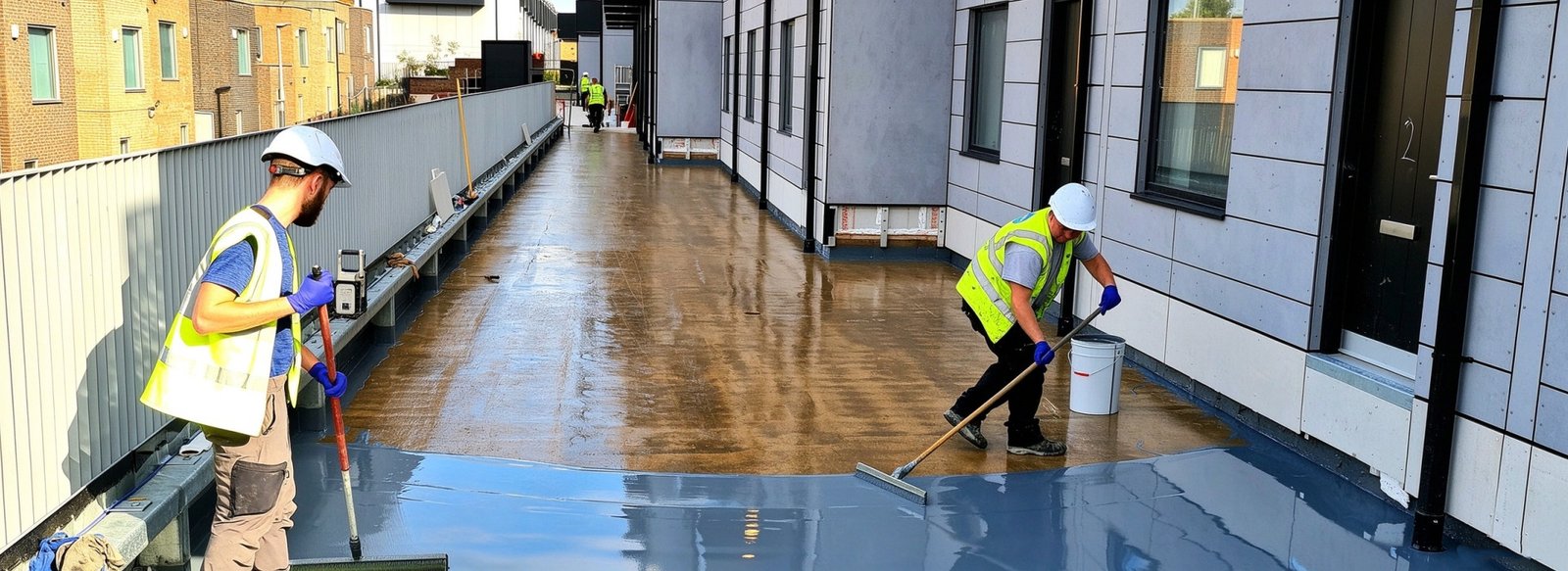
Apply first coat of CHEMPU XYT-S001 at 0.8–1.0 kg/m² using a notched squeegee or medium roller. Allow 2–4 hours tack-free drying. Apply second cross-coat perpendicular to the first to achieve a continuous 1.5–2.0 mm monolithic seamless dry film.
Flood Test & Finish Layer
Execute a 24-hour water ponding flood test to 50 mm depth to confirm zero seepage. Following sign-off, proceed with direct polymer-modified tile mortar, broadcast non-skid traffic coating, or floating pedestal paver installation.

Architectural Detailing at Thresholds & Scupper Drains
Water intrusion on balconies predominantly attacks two key structural intersections: the low-profile sliding door threshold and perimeter scupper drains.
Under the CHEMPU detailing standard, the liquid membrane must extend vertically up the door sill framing by a minimum of 75 mm (3 inches) beneath the exterior sub-sill pan flashing. At drainage scuppers, the membrane must dress into the throat of the pipe clamp ring by at least 100 mm with double-layer embedded fabric reinforcement to ensure zero lateral capillary bypass.
High-Rise Residential Balcony Remediation Project
A real-world engineering overview showing how CHEMPU hybrid liquid membranes resolve persistent balcony leaks in high-density multi-family residential towers.

High-Density Coastal Condominium Tower
Structural Challenge: A 28-story residential condominium complex located in a coastal typhoon corridor experienced widespread water seepage across 180 cantilevered exterior balconies. Original sheet membranes had embrittled and pulled away from sliding glass door framing, allowing wind-driven rain to infiltrate ceiling drywall on the units below. Complete tile tear-off was prohibited due to resident occupancy and noise constraints.
Engineering Solution: The facility management team selected the CHEMPU XYT-S001 odorless hybrid MS system. Defective perimeter grout was removed, concrete cracks were chased and injected with flexible MS sealant, and all threshold upturns were reinforced with stitch-bonded polyester fleece. A 1.8 mm monolithic coat of XYT-S001 was roller-applied across primed substrates with zero toxic odor emissions.
Deliverable Outcome: All 180 balconies completed 24-hour hydrostatic flood testing with zero water penetration detected. The high flexibility (>450% elongation) successfully accommodated structural building sway during high-wind events. The odorless chemistry allowed continuous residential occupancy throughout the entire application schedule without a single tenant complaint.
Multi-family high-rise residential cantilevers remediated in occupied building.
24-hour standing water verification at 50 mm head across all thresholds.
Solvent-free chemistry ensured zero tenant disruption during application.
Frequently Asked Questions on Balcony Waterproofing
Direct engineering answers to common procurement, design, and installation questions for exterior balcony projects. For a comprehensive comparison of products on the market, read our technical review on the best balcony membrane options.
For concrete balconies, CHEMPU XYT-S001 100% solids modified silane liquid membrane is the top recommendation. It delivers over 1.5 MPa direct concrete adhesion, bridges substrate micro-cracks up to 450% elongation, cures with zero odor and zero VOCs, and accepts direct polymer-modified tile mortar bonding without sand broadcasting.
Exterior balconies require a minimum cross-fall slope of 1:50 (2.0%) directed away from exterior walls and sliding doors toward dedicated drainage scuppers or gutters. When engineering waterproofing concrete balcony structures, a slope of 1:100 (1.0%) is permitted only under strict architectural supervision with continuous membrane upturns and zero dead-level ponding zones.
Yes, you can directly tile over fully cured CHEMPU liquid waterproofing membranes. Once the base coat reaches full cure (typically 24 hours at 25°C), use an ANSI A118.4 or ISO 13007 C2S1 high-flex polymer-modified thin-set mortar to bond ceramic, porcelain, or natural stone tiles directly to the membrane surface.
With CHEMPU fast-curing formulations, tack-free surface dry is achieved in approximately 40 minutes at standard 25°C ambient temperature, allowing you to quickly achieve a waterproof balcony. Light inspection foot traffic is permissible within 4 to 6 hours, while full mechanical furniture loading, heavy exterior planters, and over-tiling should be scheduled after 24 to 48 hours.
Yes, CHEMPU elastomeric and hybrid balcony membranes maintain high structural elasticity down to -20°C and undergo 50 freeze-thaw cycle testing without embrittlement, surface micro-cracking, or delamination. This dynamic thermal flexibility accommodates daily expansion and contraction across severe winter and summer extremes.
Yes, when specifying durable waterproofing for balcony living spaces, CHEMPU XYT-P101 traffic-bearing polyurethane deck coating containing broadcast quartz aggregates or finished under durable porcelain tiles comfortably supports outdoor lounge furniture, metal dining sets, and localized point loads without puncturing the waterproofing barrier.