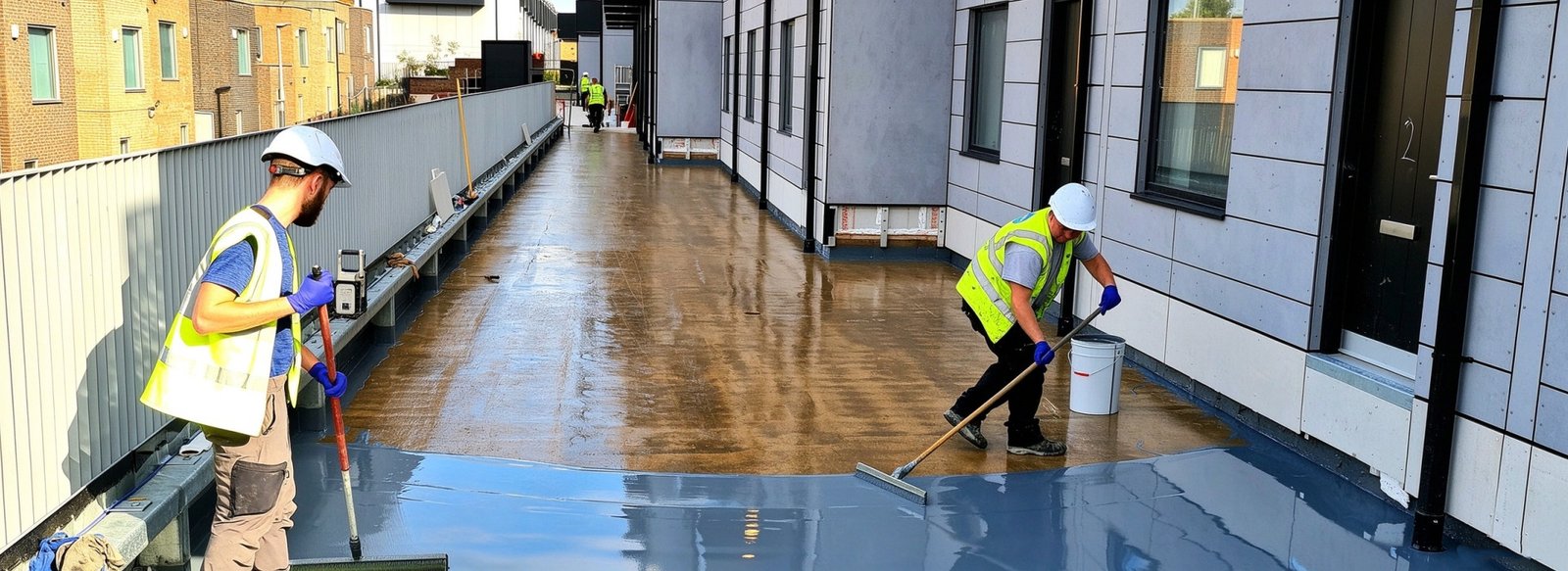
Waterproof Deck Coating Systems (Wood / Concrete / Composite)
A complete waterproof deck coating line from substrate prep to slip-resistant finish, configured around your deck material and foot traffic. Engineered with dynamic crack bridging, non-fading aliphatic UV stability, and seamless monolithic membrane protection, CHEMPU high-performance waterproof deck coatings protect pedestrian terraces, balconies, and elevated exterior platforms against relentless weathering and foot traffic.
>450% Crack-Bridging Elongation
Slip-Resistant Textured Finishes
Zero-VOC Odorless Hybrid Options
Substrate & Environmental Exposure Requirements
Selecting the optimal deck waterproofing coating depends on substrate flexural movement, foot traffic density, moisture drainage efficiency, and direct solar ultraviolet exposure.
| Deck Substrate | Pedestrian Traffic Load | Slope & Drainage Efficiency | UV & Weather Exposure | Critical Engineering Challenge | Recommended Membrane Chemistry |
|---|---|---|---|---|---|
| Exterior Timber / Wood Plank | Medium Foot Traffic | Minimum 1.5% to 2.0% positive slope | Direct Exterior UV Exposure | High hygrothermal wood movement & board joint flexing | XYT-P101 PU System with high elongation |
| Exterior Structural Plywood | Medium to High Pedestrian | Minimum 1.5% engineered fall | Direct UV & Wind-Driven Rain | Seam deflection, screw head shearing & edge swelling | XYT-S001 MS Hybrid + Mesh Seam Reinforcement |
| Poured Concrete Balconies | High Density Commercial / Residential | Flat or slope <1.0% (ponding risk) | High Solar Heat & Thermal Expansion | Structural shrinkage cracks, moisture outgassing & freeze-thaw spalling | XYT-S001 MS or XYT-P101 PU |
| Rooftop Penthouse Terraces | Leisure Furniture & Heavy Foot Traffic | Dual internal drains with sumps | Extreme UV & Temperature Fluctuation | Puncture from patio furniture, UV yellowing & zero odor required | XYT-S001 MS Polymer (Zero VOC, Odorless) |
| Wood-Plastic Composite (WPC) | Light to Medium Residential | Standard plank drainage gaps | Direct Sunlight & Ambient Rain | Low surface energy, poor chemical bonding & thermal expansion | WA-100 Acrylic or Adhesion-Promoted S001 |
| Commercial Elevated Walkways | Continuous High Pedestrian & Cart Traffic | Continuous drainage channels | Heavy Weathering & Abrasive Soil | Severe scuffing, slip hazards during rain & rapid recoat needs | XYT-P101 System + Quartz Non-Slip Topcoat |
Standard CHEMPU Deck Waterproofing Systems
Factory-manufactured liquid membranes engineered specifically for exterior deck applications, offering tailored chemistry across polyurethane, modified silane, and elastomeric polymers.
| System Model | Chemical Base | Primary Deck Target | Reinforcement & Build | Key Performance Advantage | TDS & Engineering Specifications |
|---|---|---|---|---|---|
| CHEMPU XYT-P101 | Aromatic/Aliphatic Polyurethane | Timber Decks, Concrete Balconies & High-Traffic Walkways | 3-Layer System (Primer + Base Membrane + Aggregate Wear Coat) | Extreme wear resistance, Shore A 60 hardness, >450% dynamic elongation for flexing timber | XYT-P101 deck membrane specifications |
| CHEMPU XYT-S001 | 100% Solid Modified Silane (MS) | Plywood Decks, Luxury Balconies & Occupied Terraces | Primerless monolithic coat + Polyester fabric reinforcement over seams | Completely odorless, zero solvent, UV-stable, moisture-curing on damp concrete slabs | XYT-S001 balcony and deck membrane specs |
| CHEMPU WA-100 | Elastomeric Pure Acrylic Copolymer | Low-Traffic Residential Balconies & Light Decorative Terraces | Water-based 2-3 coat build (0.8–1.0 mm dry film thickness) | Cost-effective waterborne application, breathable vapor transmission, easy roll/spray cleanup | WA-100 elastomeric coating specs |
Comprehensive Deck Waterproofing Systems Comparison
Evaluating the optimal waterproofing deck coating material requires examining mechanical tensile properties, solids content, cure cycles, and environmental endurance. Read our in-depth engineering review on best deck coating options compared for architectural procurement.
| Technical Property / Standard | CHEMPU XYT-P101 (PU Traffic Deck) | CHEMPU XYT-S001 (MS Polymer Hybrid) | CHEMPU WA-100 (Elastomeric Acrylic) |
|---|---|---|---|
| Chemical Base | Polyurethane (Moisture-Cured Elastomer) | Modified Silane Polyether (Hybrid STP) | 100% Water-Based Acrylic Copolymer |
| Solids Content by Weight (%) | ≥85% High Solids | ≥98% Ultra-High Solids (Near Solvent-Free) | ≥68% Aqueous Dispersion |
| Tensile Strength (MPa) | ≥6.5 MPa (Heavy-duty wear rating) | ≥3.2 MPa (Elastic stress relief) | ≥2.0 MPa (Surface waterproofing) |
| Elongation at Break (%) | ≥450% (Dynamic crack bridging) | ≥400% (Substrate flexure accommodation) | ≥300% (Thermal expansion bridging) |
| Tear Strength (N/mm) | ≥32 N/mm (High mechanical puncture resistance) | ≥22 N/mm (Tough flexible membrane) | ≥14 N/mm (Moderate impact tolerance) |
| Taber Abrasion Resistance | ≤30 mg loss (CS-17 wheel, 1000g, 1000 rev) | ≤55 mg loss (CS-17 wheel, 1000g, 1000 rev) | ≤120 mg loss (Light pedestrian traffic) |
| Slip-Resistant Texture Options | Broad-cast quartz (0.2–0.5 mm) or silica sand | Textured roller finish or embedded aggregate | Polymer micro-beads / sand suspension |
| UV Resistance & Color Stability | Requires Aliphatic Topcoat for full UV non-yellowing | Inherently UV-Stable (Non-yellowing, non-chalking) | Excellent UV Resistance & Solar Heat Reflectance |
| Service Temperature Range | -40°C to +90°C (-40°F to +194°F) | -40°C to +100°C (-40°F to +212°F) | -20°C to +80°C (-4°F to +176°F) |
| Tack-Free Dry Time (25°C, 50% RH) | 3 to 5 hours | 2 to 4 hours | 1 to 2 hours |
| Walkable Foot-Traffic Time | 24 hours (Full cure 72 hours) | 16 to 24 hours (Full cure 48 hours) | 12 to 24 hours (Full cure 48 hours) |
| Standing Ponding Water Resistance | Continuous immersion rating (Zero softening) | Excellent (Hydrolysis resistant polymer) | Moderate (Requires minimum 1.5% positive slope) |
| Concrete Adhesion Strength | ≥2.5 MPa (Cohesive concrete failure with primer) | ≥2.0 MPa (Primerless on dry/damp concrete) | ≥1.2 MPa (Requires acrylic/epoxy primer) |
| VOC Content (EPA Method 24) | <100 g/L (Complies with SCAQMD Rule 1113) | <10 g/L (Near zero VOC, completely odorless) | <30 g/L (Low VOC waterborne system) |
| Standard Packaging Options | 20 kg steel pails / 200 kg industrial drums | 18 kg sealed pails / 600 ml sausages | 5 kg & 18 kg plastic pails |
| Recommended Build Thickness | 1.5 mm to 2.2 mm multi-tier membrane | 1.2 mm to 1.8 mm reinforced membrane | 0.8 mm to 1.2 mm dry film thickness |
Whether your project requires high-tensile waterproof deck coatings for elevated timber framing or durable deck coating waterproofing for rooftop concrete terraces, CHEMPU provides calibrated raw material chemistry tested under stringent ISO 9001 quality controls.
Polyurethane vs. Liquid Rubber vs. Acrylic Deck Coatings
Understanding polymer mechanics is essential when specifying deck waterproof coating materials that withstand abrasive foot traffic and persistent exterior moisture.
Polyurethane Systems (XYT-P101)
Verdict: The industrial standard for heavy foot traffic and flexing wood decks. Unlike consumer-grade coatings, moisture-curing polyurethane forms a cross-linked thermoset matrix offering superior Shore A hardness (60), extreme tensile strength (≥6.5 MPa), and over 450% elongation. It permanently resists ponding water, resists scuffing from deck patio chairs, and maintains chemical bond integrity across seasonal freeze-thaw expansion cycles.
Liquid Rubber / Bitumen Emulsions
Verdict: High elongation but susceptible to mechanical tear and traffic softening. While modified liquid rubber coatings popular on retail DIY channels advertise 900% elongation, their tensile strength is typically under 1.5 MPa and surface hardness remains soft. Under summer solar heat, liquid rubber softens, tracks dirt, easily tears under dragged furniture, and blisters if moisture vapor outgasses from the substrate below.
Acrylic Elastomeric Coatings (WA-100)
Verdict: Cost-effective, UV-stable solution for sloped, light-pedestrian balconies. Acrylic coatings offer waterborne ease of application, micro-porous breathability, and high solar reflectance. However, acrylics are thermoplastic polymers that soften under continuous standing water and have lower abrasion resistance than polyurethane, making them suited for well-drained secondary balconies rather than high-traffic commercial decks.
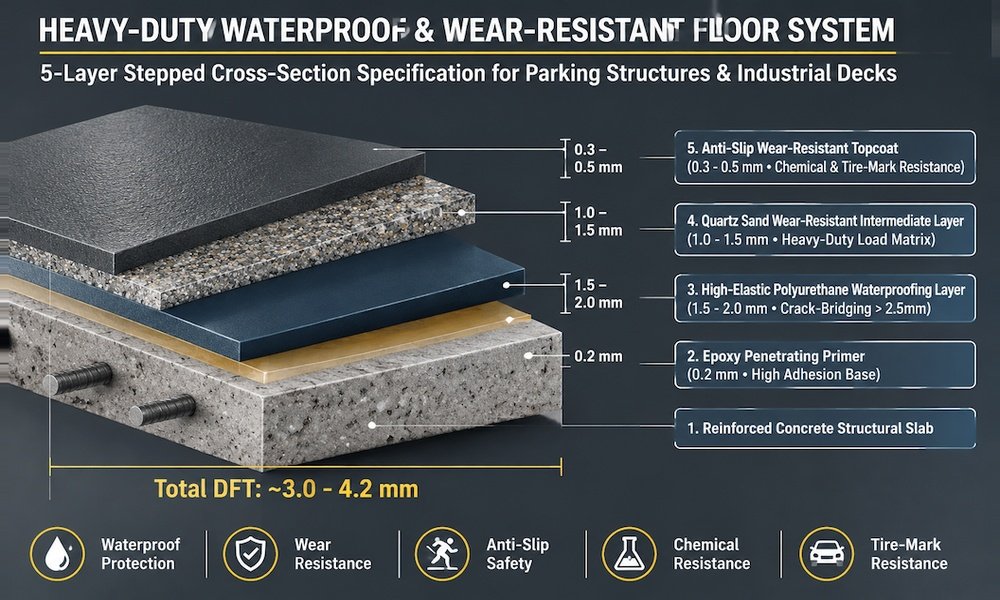
Engineered Waterproof Deck Coating for Plywood Substrates
Applying a waterproof deck coating for plywood requires strict substrate moisture control below 12% and structural deflection limits (≤L/360). Because plywood panels expand and contract at panel seams, unreinforced liquid membranes will split over joints.
The CHEMPU specification requires fastening minimum 5/8-inch tongue-and-groove exterior-rated plywood with corrosion-resistant screws spaced at 6-inch centers. All seams, perimeter flashings, and screw heads are sealed with flexible modified silane mastic and reinforced with a 4-inch alkali-resistant polyester fabric tape before applying the continuous liquid membrane.
5-Step Deck Waterproofing Installation SOP
Achieving an impenetrable, traffic-bearing monolithic deck barrier requires rigorous surface preparation and systematic multi-coat build sequence.
Surface Preparation
Mechanically grind concrete (CSP 2-3 profile) or sand timber substrate to bare wood. Remove all grease, curing compounds, and loose debris. Verify concrete moisture <4.0% or wood moisture <12% via pin meter.
Joint & Seam Detailing
Route and fill substrate cracks >1.0 mm with elastomeric sealant. Install 45-degree cant fillets at 90° wall-to-floor junctions and bed non-woven reinforcement fabric over all plywood joints and drain flanges.
Penetrating Primer Coat
Apply moisture-tolerant epoxy primer on concrete or penetrative PU primer on timber at 0.15–0.20 kg/m². The primer stabilizes the surface, blocks pinhole outgassing, and maximizes chemical cross-link bond.
Base Waterproof Membrane
Apply 2 consecutive coats of CHEMPU XYT-P101 or XYT-S001 at 1.0–1.2 mm wet film thickness per coat using a notched squeegee or roller. Allow 4 to 8 hours recoat window between passes.
Textured Wear Topcoat
Broadcast kiln-dried silica quartz aggregate (0.2–0.4 mm) to refusal into the intermediate coat. Sweep excess aggregate once cured and seal with aliphatic UV-stable topcoat for slip resistance and color retention.
Crucial Detailing at Thresholds and Drain Flanges
Over 85% of deck waterproofing failures originate at perimeter sliding door thresholds, scuppers, and floor drains rather than the open deck field. CHEMPU details these transitions with two-ply reinforcement mesh embedded in modified silane polymer, ensuring that structural building settlement never ruptures the watertight seal.
Inspect our detailed engineering drawings for floor drains, door thresholds, and expansion joint terminations prior to commencing application on multi-family residential or commercial hospitality projects.

Commercial Balcony & Terrace Waterproofing Deployment
Case study illustrating field performance of CHEMPU high-durability deck coatings on an upscale multi-residential terrace development.
A beachfront condominium development faced recurrent water intrusion through exterior suspended concrete balconies into residential units below. Previous sheet membranes suffered from perimeter debonding and seam failure under intense coastal UV exposure and tropical rainstorms.
Engineers specified the CHEMPU XYT-S001 odorless MS polymer hybrid membrane system. Balcony surfaces received mechanical shot-blasting, mesh-reinforced perimeter fillets, a monolithic 1.5 mm base barrier, and an aggregate-embedded slip-resistant UV protective topcoat.
Zero VOC emissions permitted ongoing tenant occupancy throughout application with no volatile solvent odors. Post-installation 24-hour flood testing verified complete watertight integrity across all balconies, delivering a durable aesthetic surface resistant to salt-spray corrosion.
Frequently Asked Questions on Waterproof Deck Coatings
Direct engineering answers to common procurement, substrate preparation, and installation questions.
Yes. Installing waterproof deck coating for plywood requires tongue-and-groove exterior-grade sheets (minimum 5/8-inch thickness) fastened securely to prevent joist deflection. All board joints, perimeter flashings, and screw penetrations must be pre-sealed with flexible MS/PU sealant and reinforced with alkali-resistant polyester fabric mesh before rolling the continuous waterproof membrane.
Under standard ambient conditions of 25°C (77°F) and 50% relative humidity, light foot traffic is permitted after 16 to 24 hours. Full cure for heavy furniture, commercial traffic, and exposure to water ponding testing requires 48 to 72 hours to achieve maximum Shore hardness and abrasion resistance.
Yes. CHEMPU waterproof deck systems include an optional aggregate-broadcast textured wear layer. Kiln-dried silica quartz (0.2–0.4 mm) or polymer texturing beads are broadcast into the intermediate coating layer, followed by a protective lock-down topcoat, ensuring a safe, non-slip walking surface even in rainy wet conditions.
For concrete balconies and terraces, CHEMPU XYT-S001 modified silane or XYT-P101 polyurethane elastomeric systems deliver optimal deck waterproof coating reliability. S001 provides zero-odor, primerless adhesion with complete UV stability on luxury residences, while P101 offers maximum tensile elongation (>450%) and heavy vehicular wear tolerance for multi-story parking and commercial pedestrian plazas.
Primer necessity depends on the chemical system and substrate porosity: while XYT-S001 MS polymer achieves tenacious adhesion to sound dry concrete without primer, porous exterior plywood, weathered timber, and moisture-prone concrete slabs require an epoxy vapor-barrier or polyurethane penetrating primer to prevent pinholes, outgassing bubbles, and premature edge peeling.
When specified and applied to correct film build with periodic topcoat renewal every 5 to 7 years, high-performance industrial deck coating waterproofing systems deliver a continuous service life exceeding 10 to 15 years under direct UV exposure and intensive foot traffic.
Request Deck Waterproofing Specification & Pricing
Direct response from CHEMPU Technical Sales within 2 hours. OEM/ODM custom branding and export container logistics supported.